A Portrait of the Artist as a Young Man

Updated: Mar 29, 2023
A novel by James Joyce
About the Author
James Joyce (1882-1941) was an Irish writer and one of the most influential modernist authors of the 20th century. He was born in Dublin, Ireland, and spent much of his life there, though he also lived and worked in other cities, including Paris and Trieste.

Joyce is best known for his novels, which include "Dubliners," "A Portrait of the Artist as a Young Man," "Ulysses," and "Finnegans Wake." His works are known for their experimental style, use of stream-of-consciousness narration, and complex themes and symbolism.
Joyce's writing is also noted for its detailed portrayal of Irish life and culture, particularly in Dublin, and its exploration of themes such as identity, sexuality, religion, and politics. His works have had a profound impact on modern literature and continue to be widely read and studied today.
Joyce's life was marked by personal and professional struggles, including poverty, illness, and censorship. However, he remained dedicated to his writing throughout his life and is widely regarded as one of the most important writers of the 20th century.
Recap of the Novel
The novel is considered to be somehow an educational novel, it is kind of ancient, but with a modern character. It expresses the child's transition from childhood to adulthood, from ignorance to knowledge, and his cultural, moral, and psychological development, and it represents development itself in different aspects. The protagonist of the novel is named Stephen Dedelus, a name that originated from the Greek legend of Daedalus. The name itself, Stephen, is kind of a strange name in Ireland, which is not considered typical at that time except among Christian Catholics, and in Greece, it represents one of the Christian martyrs.
The first chapter begins with a quote from the poems book of Metamorphoseon or Transformations written by the Roman poet Ovid, the quote is "And he sets his mind to unknown arts". This line appears in the Book of "Metamorphoses" where Ovid is describing the transformation of the young sculptor Pygmalion, who falls in love with his own ivory creation and prays to Venus to bring her to life. The line is used in "The Portrait of the Artist as a Young Man" to signify the protagonist's decision to pursue a life in the arts despite the expectations of his family and society. The novel begins with the main character, Stephen Dedalus, as a young child. The opening scene is a memory of Stephen's father, Simon, telling him a bedtime story or something like a lullaby when he said "once upon a time". The story is about a moo-cow, a playful and gentle tale that reflects the innocence of Stephen's early childhood. This in itself indicates that the writer wrote the novel from a young age until he grows up, it is a woven tapestry from childhood to adulthood as if the writer wrote the first chapter at a young age, then woven the second chapter in another decade of his life, then wrote the third chapter at an older age and so on. Stephen is surrounded by his family, including his mother, siblings, and Dante.
The author began in the first chapter with a childish description of some people and events, for example, he described his mother with a beautiful smell and his father with a monocle. It is a simple expression of being a child. Once Stephen told his mother at a time, I would marry Alain, his Christian Protestant neighbor, and at that time he belonged to a Catholic family, his mother told him, apologies, apologize, pr the eagle will come to pull out your eyes. Stephen's early memories also include attending Clongowes Wood College, a Jesuit-run boarding school. Stephen described how he felt isolated when he went to this school, as many boys bullied him because of his weird name in Ireland. Another day, Stephen played football in two teams named York and Lancaster, which are more symbols than just simple names of football teams. The White Rose ball team represents the Yorks, who were fighting for the English throne during the Wars of the Roses, while the Red Rose team represents the Lancastrians, who were also vying for control of the throne. This is a reference to the historical conflict between the House of York, symbolized by a white rose, and the House of Lancaster, symbolized by a red rose. The conflict lasted from 1455 to 1487 and was one of the bloodiest periods in English history. Stephen, while sitting to watch the game, wondered why there was no green Rose, and this represents the child's inner subconscious since Green also represents the Irish nationalist movement that seeks the independence of Ireland from Britain. At Clongowes, Stephen struggles to fit in with the other boys. He is frequently bullied and feels isolated. One significant event in this chapter is when Stephen is pushed into a ditch by a fellow student, Wells. Stephen becomes ill as a result of the incident, and his classmates and teachers show little sympathy for him. This experience highlights Stephen's vulnerability and emphasizes his feelings of loneliness.
Another important incident was when Stephen had been accused of not returning a book on time, but he claimed that he had returned it and that the accusation was false. Despite his protests, Father Dolan punishes Stephen by beating him with a pandybat, a leather strap used for corporal punishment. Stephen feels that he has been unfairly punished, as he believes that he did nothing wrong. He is also upset by the fact that Father Dolan did not listen to his side of the story and instead chose to believe the accusation made against him. Stephen's experience with Father Dolan and his punishment is a pivotal moment in the novel, as it marks his growing disillusionment with the strict and oppressive authority figures in his life, including his teachers and the Catholic Church. The incident also highlights the theme of injustice and oppression in the novel, as Stephen becomes increasingly aware of the ways in which he and others are controlled and limited by the social and religious institutions of his time. Stephen here described the situation by saying the term "epiphany moment" taken from Aristotle, Stephen realized that the church is not more interested in religion than in discipline and fear.
The second chapter tells about Stephen, a teenager who moved to another school and to a second more impoverished neighborhood than the first neighborhood due to the debts of his father, which led to the transformation of Stephen and his family from the middle class to the poor class, which made Stephen feel that he wanted to get out of this class and did not want to be affected by it. Here Stephen began reading literary works such as The Count Of Monte Cristo, a famous novel that tells about the adventure of the hero Dantes, who was betrayed by his friend and put in prison and then came out of prison after almost ten years and became rich and powerful and wanted revenge on his friend. The story also contains power, revenge, love, and romance, and when mentioning love and romance, both represented by Mercedes, Dantes ' girlfriend, for Stephen, Mercedes was the first stereotype about the female, being passionate, feminine romantic, and wondering if there is a girl like Mercedes.
In another scene, Stephen is asked to identify his favorite prose writer and poet, and he chooses
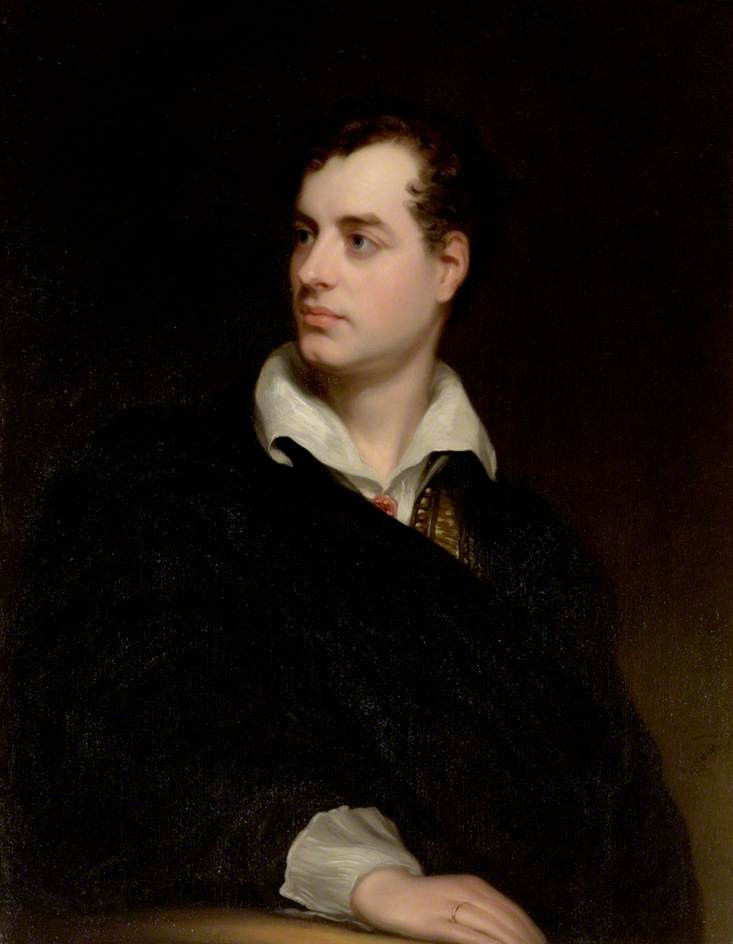
Cardinal Newman and Byron, respectively. Byron and Newman are two contradictory characters because they are very different. Lord Byron is a Romantic poet, who represents aesthetic inspiration. He is associated with beauty, pleasure, and self-expression.

He embodies the freedom to pursue individual desires and the rejection of traditional moral and social constraints. Byron's poetry celebrates passion, individualism, and rebellion against authority. On the other hand, John Henry Newman, a 19th-century theologian, represents religious motivation. He is associated with faith, piety, and obedience to God. He embodies the belief in
a higher authority and the rejection of secular pleasures and desires. Newman's religious writings celebrate submission, humility, and self-denial. Joyce presents these two characters as opposing forces, each representing a different aspect of the human experience. Stephen struggles to moderate these contradictory notions within himself. He is torn between his desire for artistic expression and his religious upbringing, and he finds himself in conflict with his family and society as a result.
In this chapter, Stephen also sees his father as a failure financially who also has a symbolism related to Daedalus, the Greek inventor of the maze, when he threw his son Akros into the maze. Daedalus is known for his skill as a craftsman and his ability to create complex inventions, such as the labyrinth in which the Minotaur was held. However, he was also a flawed father who failed to protect his son, Icarus, from harm. Daedalus crafted wings made of feathers and wax so that he and his son could escape from Crete, but he warned Icarus not to fly too close to the sun, as the heat would melt the wax and cause the wings to fail. Icarus, overcome by the exhilaration of flight, ignored his father's warning and flew too close to the sun, causing his wings to melt and leading to his tragic death. Similarly, Stephen's relationship with his father is marked by both admiration and disappointment. Stephen looks up to his father for his intelligence and political convictions, but he also feels estranged from him due to their religious and ideological differences. Like Daedalus, Stephen's father is a flawed figure who is unable to provide his son with the guidance and support he needs to navigate the complexities of life.
In this chapter, Stephen also engages in a sexual relationship with a girl named Emma. The relationship occurs when Stephen is a teenager, and it is depicted as a brief and somewhat awkward encounter. The scene in which the encounter takes place is narrated from Stephen's perspective, and it is clear that he is both physically and emotionally inexperienced. Stephen is described as feeling nervous and uncertain, and he struggles to understand his own desires and feelings. Afterward, Stephen experiences a range of conflicting emotions, including guilt, shame, and a sense of loss. The sexual relationship with Emma is significant because it is one of the first instances in which Stephen begins to explore his own sexuality and desires. It is also important because it highlights the tension between Stephen's Catholic upbringing and his burgeoning artistic and intellectual interests. The guilt and shame he feels after the encounter is a result of the conflicting messages he receives from his religion and his own desires. In describing the relationship, Stephen emphasizes the physical and sensual aspects of the encounter, while also acknowledging the religious implications. He describes Emma's body in detail, noting her "white throat, the whiter breasts," and the "soft rope of her hair." At the same time, he recognizes that what he is doing is sinful and in conflict with his Catholic faith. He feels "a vague terror" and "a sense of sin" that he cannot fully articulate. Stephen's conflicting emotions in relation to the sexual encounter with Emma reflect the broader tension between religion and art that runs throughout the novel. For Stephen, his religious beliefs represent a kind of prison that he must escape in order to fully realize his artistic and intellectual potential. The sexual encounter with Emma represents a moment of liberation and rebellion, but it is also tinged with guilt and shame, highlighting the difficulty of breaking free from the constraints of his faith.
In the third chapter, we can see that Steven begins to think a lot about his initial sexual relationship, which represents Steven's regret for the first time in almost all his writings. It should be noted here that Joyce was influenced by Aquinas, a Dominican monk, and Catholic priest known as the angelic world, when he said who made one mistake, it is the opener of his future mistakes, and who broke the commandment of the seven sins, he broke all sins. The third chapter is my favorite chapter. The chapter talks about many things, such as the fall of Lucifer from heaven to hell and the talk about Adam and Eve. Stephen abandons himself to reflect on his mistakes and sins committed after taking a few lessons about Heaven, Hell, the afterlife, reckoning, and death. After the retreat, Stephen decides to start all over again without sins, and Stephen decides to go to a distant church to confess to the priest about the mistake and ask for forgiveness. In Catholic doctrine, Once a person commits a great sin, he creates a great veil between him and God. Stephen's thoughts turn to the story of Adam and Eve and their expulsion from the Garden of Eden. He reflects on the idea that the fall of humanity was not just the result of Eve's disobedience, but also the fault of Adam and even of Lucifer, the fallen angel. Stephen imagines Lucifer as a "pride of intellect" who refused to serve God and was cast down to hell. He compares Lucifer's rebellion to his own desire for independence and his refusal to submit to the authority of the Church. He also notes the connection between the name "Lucifer" (which means "light-bearer") and the image of the sun rising in the morning, which he sees as a symbol of intellectual awakening and enlightenment. Regarding Adam and Eve, Stephen reflects on the idea that Adam was also guilty of sin, even though he did not eat the forbidden fruit himself. He sees Adam's passivity and lack of moral courage as a form of complicity in Eve's sin and notes that the biblical story can be read as a warning against the dangers of blindly following authority and tradition.
The fourth chapter of "The Portrait of the Artist as a Young Man" is a pivotal moment in the novel, as it marks Stephen's decisive break from the religious and cultural traditions of his upbringing. In this chapter, Stephen rejects his Catholic faith and embraces the life of an artist, setting out on a journey of self-discovery and creative exploration. Some important subjects and themes in this chapter include:
Stephen's rejection of Catholicism: Stephen begins to question the teachings of the Church and to reject the idea of sin and damnation. He sees the Church as a repressive and stifling force that prevents him from expressing his true self and pursuing his artistic ambitions.
Stephen's embrace of art and beauty: Stephen becomes increasingly drawn to the world of art and aesthetics, seeing beauty and creativity as a way to transcend the limitations of the everyday world. He begins to see himself as an artist, with a mission to create and express his own unique vision of the world. Stephen's search for identity: As he breaks away from his religious and cultural heritage, Stephen struggles to define his own identity and to find a sense of belonging in the world. He feels isolated and alienated from his family and his community, but also excited and liberated by the possibilities of his new life.
Stephen's exploration of sexuality: In this chapter, Stephen begins to explore his own sexuality and experiment with relationships with both men and women. He sees sex as a natural and vital part of life and rejects the Church's condemnation of it as sinful and immoral.
The fifth chapter of "The Portrait of the Artist as a Young Man" is a reflection on Stephen's time at the university and his growing sense of alienation from his peers and from the world around him. The chapter is divided into several sections, each of which explores a different aspect of Stephen's life and consciousness. Some important subjects and themes in this chapter include:
Stephen's intellectual pursuits: Stephen immerses himself in his studies, reading voraciously and seeking out new ideas and intellectual challenges. He begins to see himself as a kind of intellectual outsider, a "heresiarch" who questions the conventional wisdom of his peers and teachers.
Stephen's sense of isolation: Despite his intellectual curiosity, Stephen feels increasingly isolated and alone at the university. He struggles to connect with his classmates and find a sense of belonging in the academic community. He also feels a sense of estrangement from his family and from his Catholic upbringing. Stephen's artistic ambitions: Stephen continues to see himself as an artist, and begins to explore the possibilities of writing as a way to express his ideas and emotions. He begins to experiment with different forms of writing, including poetry and prose and begins to develop his own distinctive style and voice. Stephen's struggles with faith and doubt: Despite his rejection of Catholicism, Stephen continues to grapple with questions of faith and doubt. He is haunted by the memory of his religious upbringing and continues to feel a sense of guilt and shame over his rejection of the Church. At the same time, he begins to explore other spiritual and philosophical traditions, including the ideas of Plato and Aristotle.
Comments